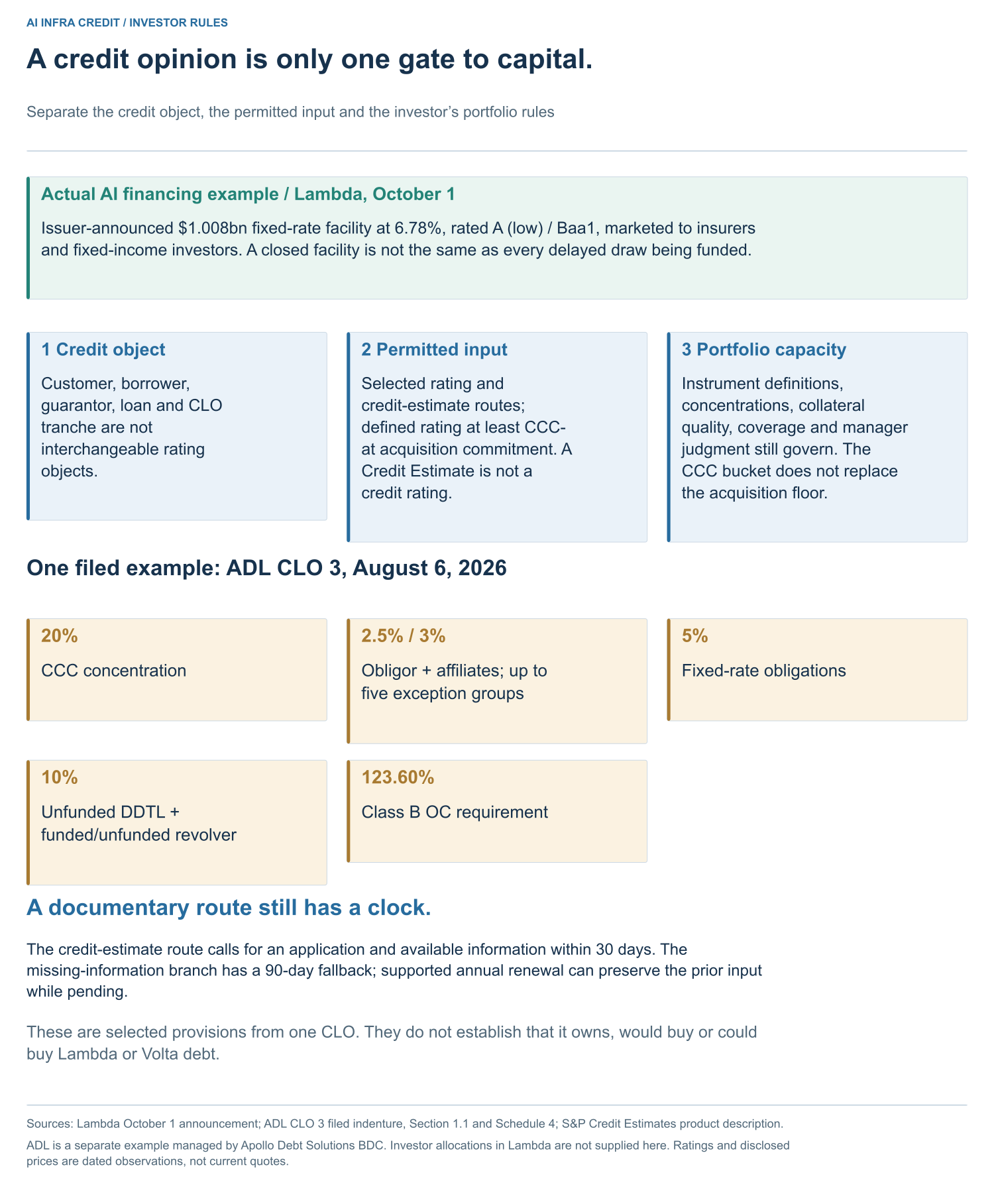
A credit rating can help a financing reach more investors, but it does not allocate their money. The credit object, the input an investor's rules recognize and the capacity left in its portfolio are separate questions. Understanding that separation is part of expanding the capital available for AI—not just explaining why a particular loan is expensive.
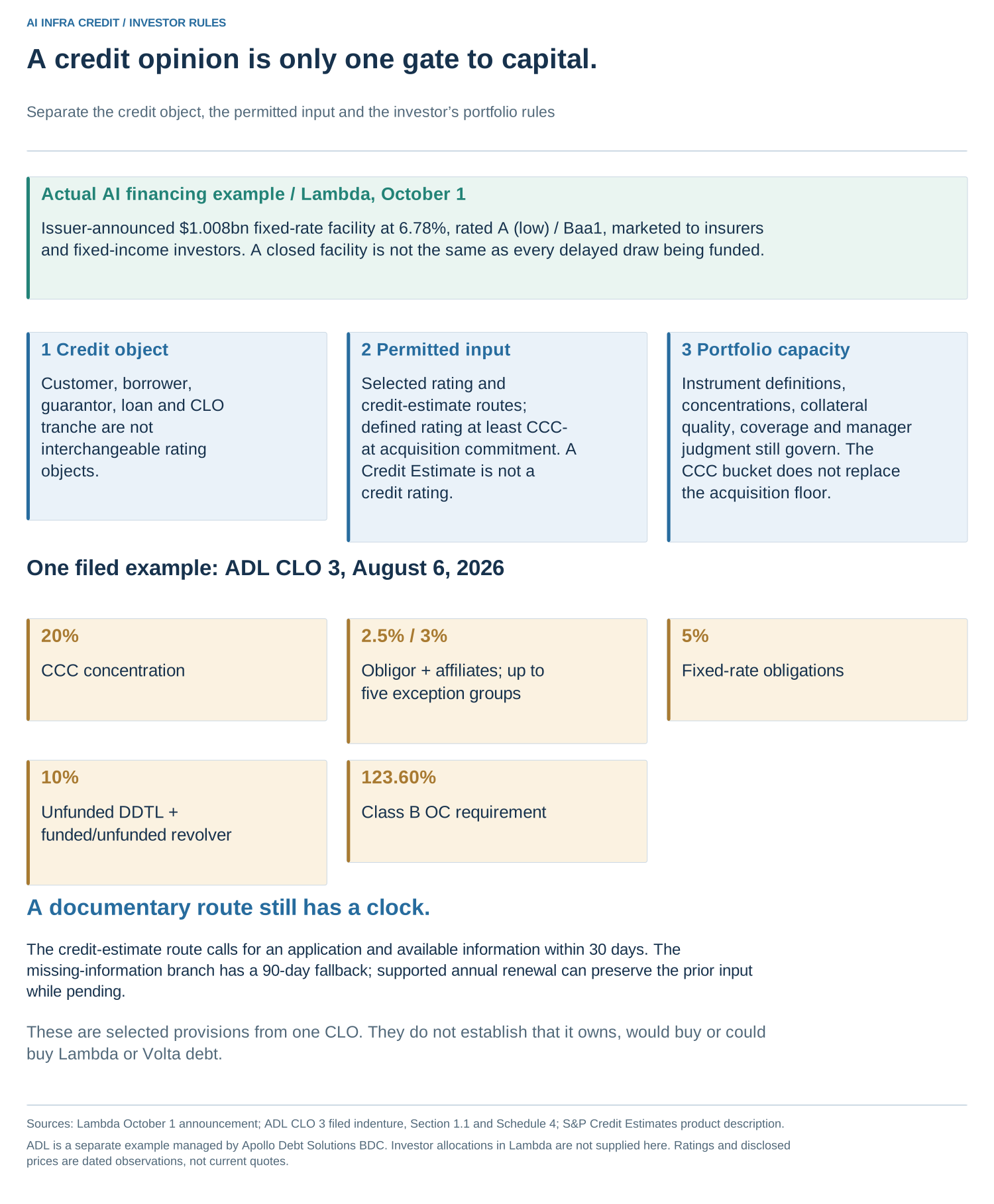
Lambda supplies a constructive example. On October 1, it announced the closing of a $1.008bn fixed-rate delayed-draw facility marketed to insurers and fixed-income investors, with announced A(low)/Baa1 ratings and a 6.78% rate. The structure connects contracted deployments with an institutional financing format. The release does not identify each investor's allocation or isolate the causal value of the ratings. Lambda announcement.
The buyer universe has a contract boundary
A collateralized loan obligation, or CLO, holds loans and finances them through layers of securities and other debt. Here the question is which loans the vehicle can hold, not who is legally eligible to buy its own notes.
One concrete rulebook is the August 6, 2026 indenture of ADL CLO 3, a subsidiary of Apollo Debt Solutions BDC. This is a separate, filed transaction—not evidence that this CLO owns or could buy Lambda or Volta debt. The filing identifies the vehicle, manager and closing. Apollo Debt Solutions 8-K.
Its asset definition requires an indenture-defined S&P Rating of at least CCC- at the commitment to acquire and excludes specified instrument types. Selected concentration limits include 20% CCC exposure, ordinarily 2.5% per obligor and affiliates, with up to five groups at 3%, and 5% fixed-rate exposure. The CCC bucket does not replace the acquisition rating floor. These are this document's limits, not universal CLO thresholds. Indenture, Section 1.1.
Definitions matter as much as labels. The excluded Step-Down Obligation concerns a rate reduction solely with time; a rating-triggered reduction is not automatically the same thing. The defined Bridge Loan is narrower than every facility called a bridge. SPV form alone does not satisfy the document's multi-part Structured Finance Obligation definition, and excluding a lease does not automatically classify a loan financing leased equipment.
For AI financing, this changes the task. A recognizable sponsor, valuable GPUs and a large customer contract may be relevant to credit quality, but they do not resolve the buyer's instrument definition, group exposure or portfolio limits. The appropriate capital provider must be matched to the actual claim being sold.
A credit estimate is not a credit rating
S&P describes a Credit Estimate as a confidential, abbreviated, point-in-time indication—not a credit rating or a substitute for one. Such estimates can nevertheless be inputs in structured-finance analysis. S&P Credit Estimates.
The ADL contract permits a credit-estimate route within its defined rating methodology. It includes application and information requirements within 30 days, a specified missing-information branch with a 90-day fallback, and annual renewal provisions. A timely, information-supported renewal can preserve the prior estimate pending review. Recent rating withdrawals have separate treatment. Indenture, Schedule 4.
The practical distinction is between a public credit opinion and a permitted contractual input. It is therefore too broad to say that every loan without a public rating is automatically inaccessible to every CLO. It is equally wrong to treat a manager's unsupported opinion as a freely interchangeable public rating.
The rated entity also matters. A customer's credit can affect the reliability of project receipts, while an investor's contract may ask for a borrower, obligation or qualifying-guarantor input. Moving a customer's rating into the borrower's field would skip the legal and economic link. This is why the two reported rating descriptions in the Volta case remain separate.
One test can change without new cash
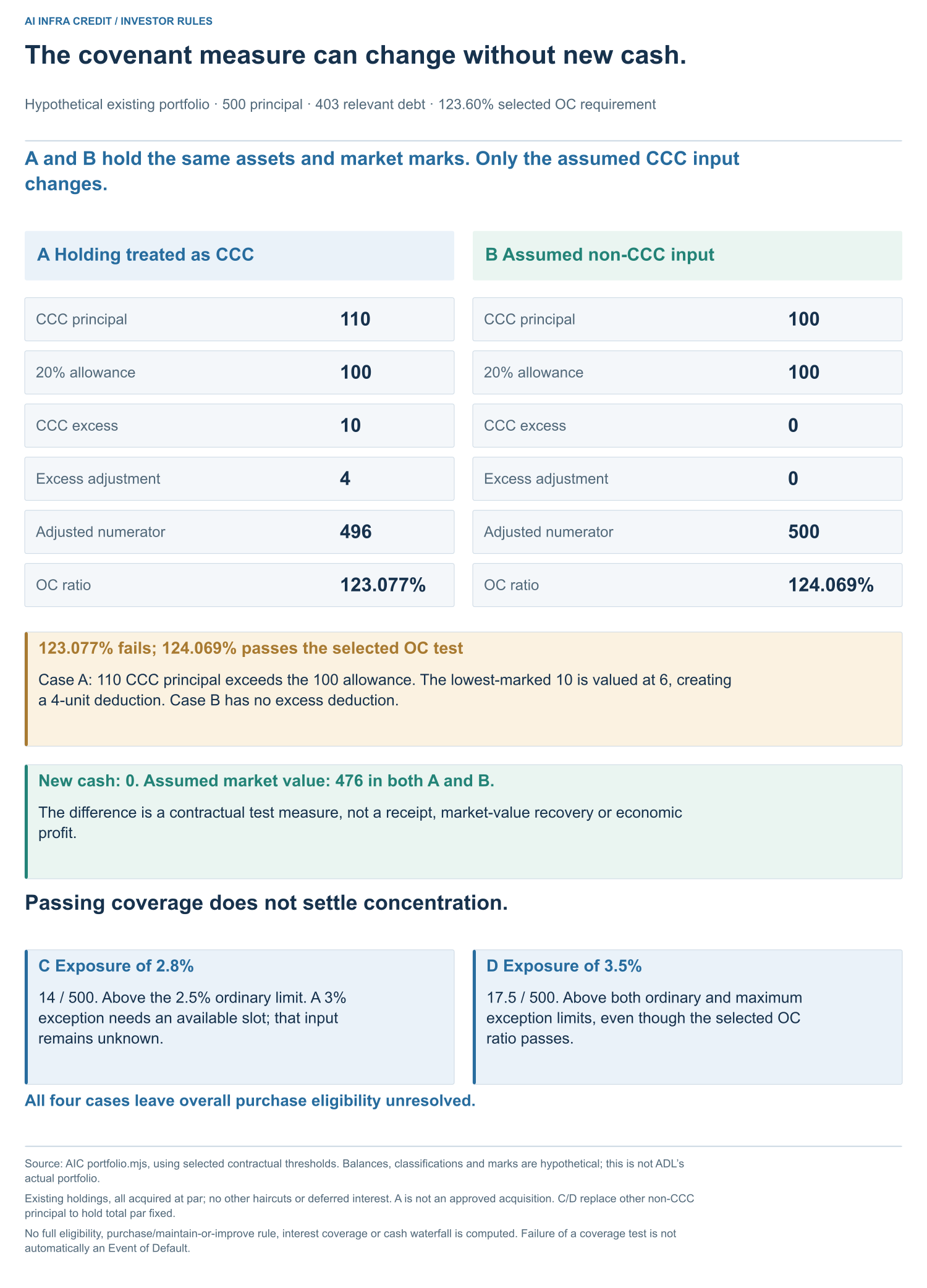
Consider an already-held hypothetical portfolio, not a proposed purchase or ADL's actual holdings. Total principal is 500; the relevant debt denominator is 403. Other CCC assets total 100 at an assumed 80% market mark. A separate 10-unit holding is marked at 60%; the remaining 390 is non-CCC. All assets were acquired at par, and other collateral adjustments and deferred interest are excluded.
Apply the selected contract's 20% CCC allowance and 123.60% Class B overcollateralization requirement. Overcollateralization, or OC, compares an adjusted collateral numerator with the relevant debt denominator. The selected CCC-excess adjustment uses the lowest market-value assets first.
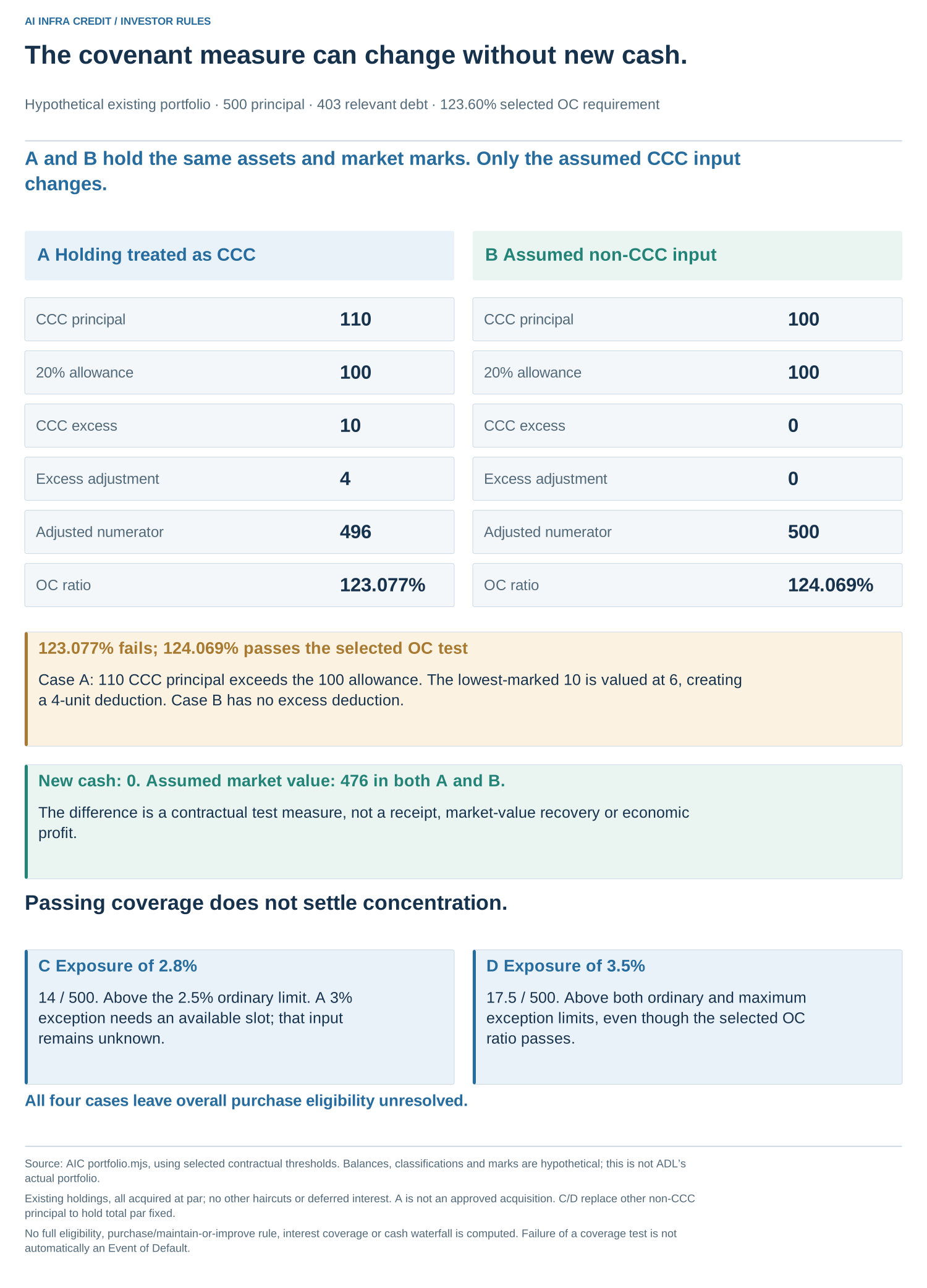
In case A, treating the 10-unit holding as CCC brings CCC principal to 110. The excess over 100 is the lowest-marked 10, whose market value is 6. The four-unit adjustment produces 496 / 403 = 123.077%, below the selected requirement. This state is already above the CCC concentration limit; it is not presented as a permissible new acquisition.
In case B, an assumed non-CCC input for the same holding leaves CCC principal at 100. No excess adjustment arises, and 500 / 403 = 124.069%. The test passes. No cash has arrived, no market value has recovered and no economic profit has been created. The assumed portfolio market value remains 476 in both cases. This is a controlled comparison of contractual measurement, not an assumed public rating upgrade.
At applicable test dates, a coverage breach can redirect available cash through the indenture's payment priority and mandatory-redemption provisions. That is not automatically a borrower default, liquidation or an Event of Default. The calculation does not model a full waterfall or a cure payment. Indenture, Sections 9.1 and 11.1.
Passing coverage does not create unlimited room
Increase a hypothetical non-CCC obligor-and-affiliate exposure to 14 while keeping total principal at 500 by replacing other non-CCC assets. Its 2.8% share needs an available 3% exception; that availability is unknown. At 17.5, the 3.5% share exceeds even the stated maximum. The selected OC ratio still passes in both examples.
That is the point of separating the tests. A credit input can improve one measure while another constraint still binds. Industry, geography, life, fixed-rate exposure, unfunded commitments, asset eligibility and the manager's judgment can also matter. Every model case therefore leaves overall purchase eligibility unresolved. No modeled result approves a trade or identifies an actual buyer.
What this changes for AI funding
The useful financing work is to identify the target capital pool early, supply the information its analysis requires and make the actual debt claim fit the economics of delivery and repayment. A clear borrower, enforceable support, credible cash-flow evidence and maintained documentation can widen the set of institutions able to assess a transaction. They do not guarantee a rating outcome or an allocation.
For research users, keep four fields separate: the rated entity or instrument, the accepted input route, the portfolio constraint and the funded allocation. A lower coupon answers only one part of the funding question. The next advance in AI capital formation may come from making productive projects understandable and compatible with more investors' rules—not from assuming a single market-wide borrowing rate.
Download the source-linked rules and assumptions, selected-test calculator, results, checks, figure generator and reuse guide. Full-size PNGs: capital gates and portfolio tests.