Anthropic’s first public S-1 shows a company that has already raised substantial capital—not a company that burned $80.7 billion of cash in six months. Its June accounts report positive operating cash flow and $110.432bn of net preferred-equity proceeds. The next financing question sits in the contracts: when additional capital becomes available, when suppliers must deliver, and when payment obligations begin.
That is a constructive finding for AI expansion. Equity has already supplied risk capital; supplier arrangements can support more capacity. But these routes do different jobs. A capacity milestone can unlock financing, acceptance can unlock service fees, and equipment rent can sometimes begin before a delayed facility is ready. The cash clocks do not automatically line up.
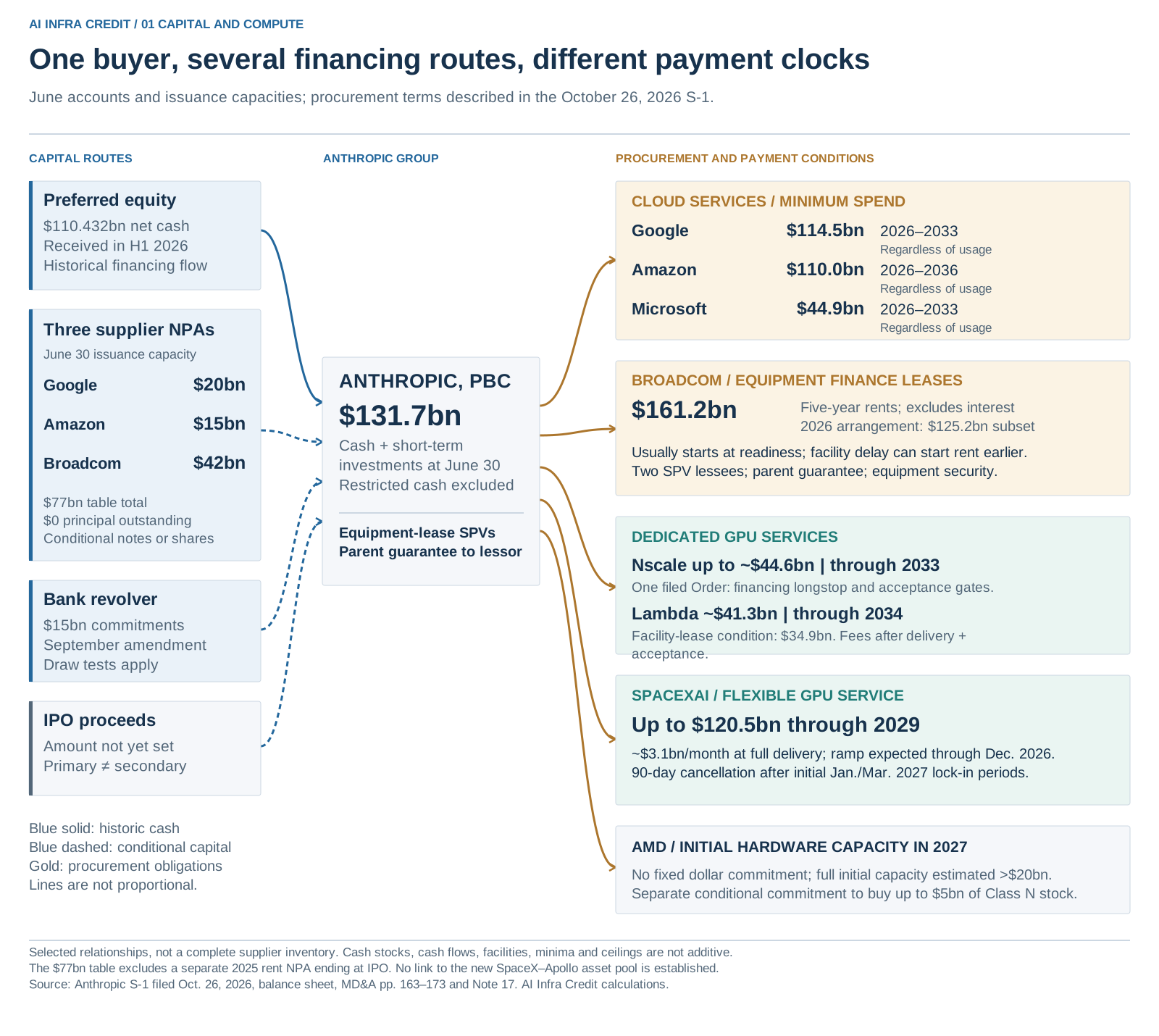
Open any figure for the full-size view. Financial observations below are the unaudited six months ended June 30, 2026. Contract descriptions include later amendments disclosed in the October 26 filing. Neither the June cash balance nor the historical financing receipts are October cash observations. Anthropic S-1, financial statements and MD&A.
The loss headline is not the funding requirement
Anthropic reported $16.286bn of revenue, a $0.693bn operating loss and an $80.748bn net loss for H1. Its cash-flow statement reports +$3.929bn of operating cash. Most of the gap between net loss and operating cash comes from non-cash financial-instrument adjustments—not cash coming back from a loss-making transaction.
The reconciliation adds back $72.388bn for changes in the fair value of convertible notes, derivative liabilities and SAFEs, plus $8.720bn for recognition and fair-value changes in other financial instruments. Stock compensation contributes $2.185bn and other non-cash rows a net $0.216bn. Working-capital changes add $1.168bn. Those components reconcile exactly to reported operating cash.
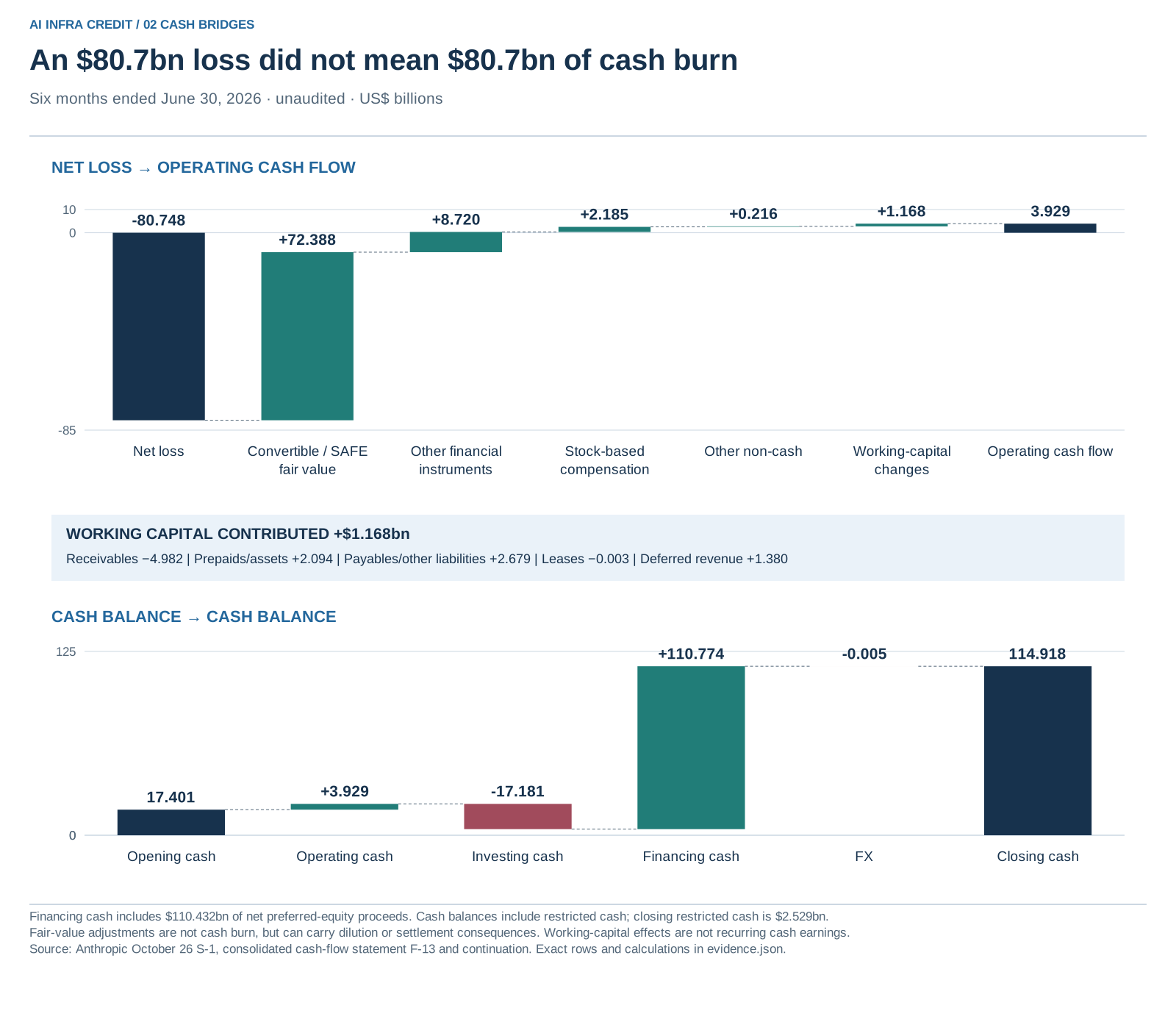
The favorable observation is that reported operating cash was positive. Its durability remains an operating question. Receivables absorbed $4.982bn while prepaids and other assets released $2.094bn, payables and other liabilities contributed $2.679bn, and deferred revenue contributed $1.380bn. These timings can move. Removing non-cash charges also does not erase dilution, seniority or future settlement economics. S-1, cash-flow statement F-13 and MD&A p. 169.
The much larger capital event was equity. Net preferred-stock cash proceeds were $110.432bn. Total financing cash of $110.774bn, operating cash of $3.929bn, investing cash of −$17.181bn and FX of −$0.005bn produced a $97.517bn increase in cash including restricted balances. Closing cash on that scope was $114.918bn. Separately, cash and equivalents of $112.389bn plus short-term investments of $19.262bn totaled $131.651bn, excluding $2.529bn of restricted cash.
Cash purchases of property and equipment were only $0.482bn. That is not a measure of all compute consumed or contracted: cloud services, equipment leases and future purchases enter different accounts and payment periods. It is also why subtracting current cash capex from CFO cannot settle the economics of the future buildout.
The suppliers can provide capital without providing day one cash
The S-1’s page-166 table shows $77bn available for issuance across three undrawn facilities at June 30: Google $20bn, Amazon $15bn and Broadcom $42bn. Principal outstanding under all three was zero. Each has a different path from a headline amount to usable financing.
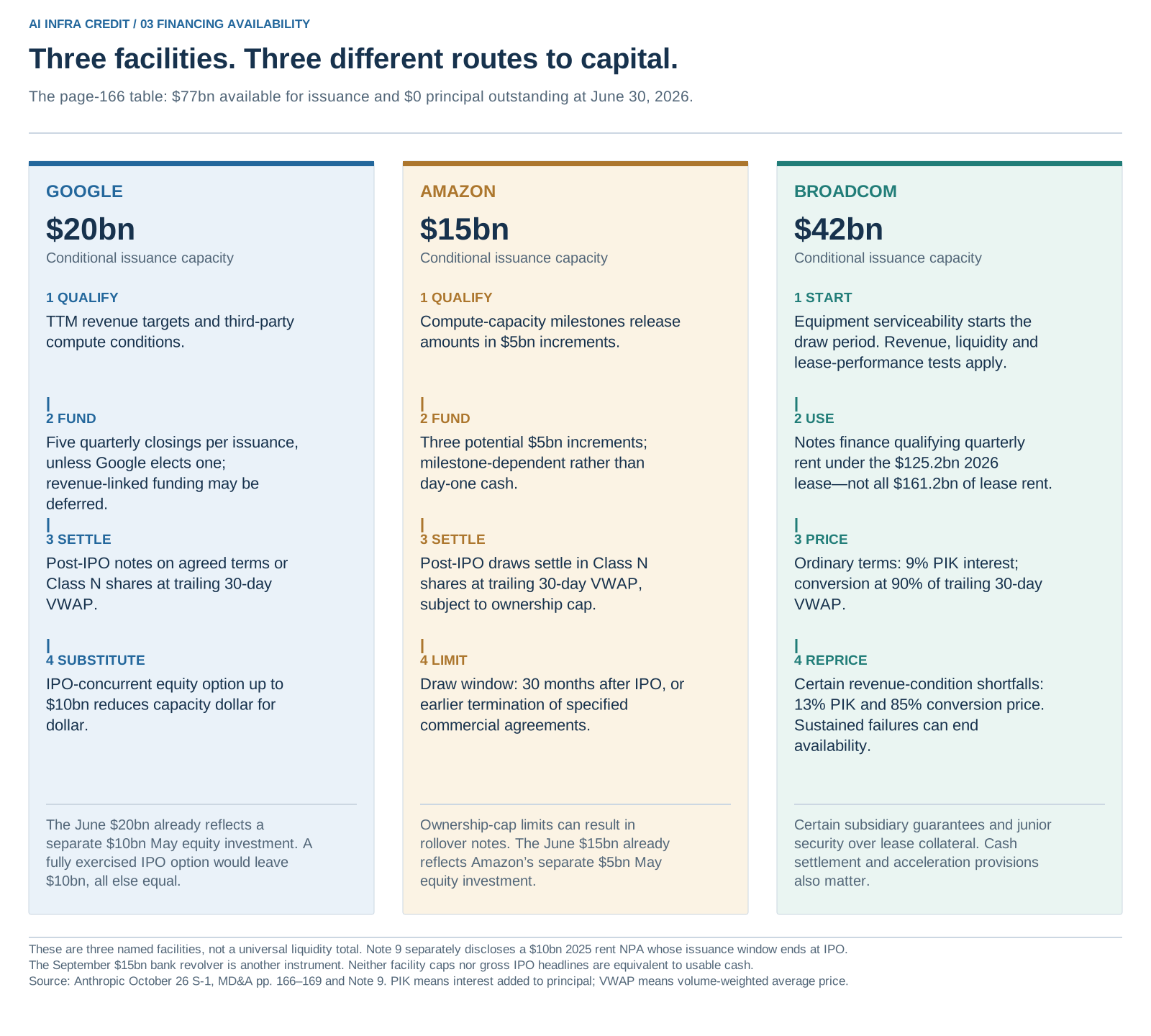
Google: specified revenue targets and third-party compute conditions govern issuance requests. Funding ordinarily occurs over five quarterly closings unless Google elects a single closing, and Google can defer revenue-linked draws. Post-IPO funding can involve agreed notes or Class N shares. A separate option to purchase up to $10bn of stock alongside the IPO would reduce remaining facility capacity dollar for dollar—not add another independent $10bn of unused financing. The June $20bn already reflects an earlier May equity investment.
Amazon: amounts become available in $5bn increments when relevant compute-capacity milestones are achieved. Post-IPO draws settle in Class N shares at the specified trailing VWAP, subject to ownership-cap and rollover-note provisions. The draw window ends 30 months after the IPO or earlier if specified commercial agreements terminate. This is a link between capital availability and capacity delivery, not a promise of $15bn of immediately available cash.
Broadcom: the $42bn facility finances qualifying quarterly rent under the $125.2bn 2026 Lease Arrangement. That arrangement is part of the broader $161.2bn lease-rent aggregate; the three numbers must not be added. The ordinary note terms include 9% payment-in-kind interest and conversion at 90% of trailing VWAP. Notes issued during certain revenue-condition shortfalls carry 13% PIK interest and an 85% conversion price. Sustained failures can terminate issuance availability. Serviceability, revenue, liquidity and lease-performance conditions matter alongside the cap. S-1, MD&A pp. 166–169 and risk factors.
The three-facility table is not every financing instrument. Note 9 separately describes an undrawn $10bn 2025 rent-financing NPA whose issuance window ends at IPO. The September amendment also created a $15bn bank revolver with a $5bn minimum-liquidity covenant. Neither belongs inside the same $77bn table, and none should be stacked on top of a June cash balance without dates and conditions.
The constructive interpretation is that partners can help finance expansion as demand and capacity develop. The economic trade is dependence on those same partners, ownership dilution or note obligations, and financing that may become less attractive precisely when performance weakens.
Acceptance protects the buyer and creates a funding interval for the builder
The S-1 describes up to approximately $44.6bn of Nscale services through 2033 and approximately $41.3bn of Lambda services through 2034, with fees accruing as capacity is delivered and accepted. These are material customer relationships, but their timing matters as much as their headline size.
One Nscale Order filed in Nscale’s own September S-1 shows financing architecture inside the procurement contract. Four separate agreements were used to facilitate financing while preserving coordinated site operations. The provider must use best efforts to obtain qualifying financing. Failure to secure it by a redacted longstop gives each party a written termination right within a specified window; it does not automatically terminate the deal. Nscale Exhibit 10.25, Order §§1(c), 9(a) and 9(d).
Acceptance needs equally careful treatment. Order §5 calls for written acceptance before fees, while Terms §3.2 also provides deemed acceptance if Anthropic supplies neither written acceptance nor a detailed rejection within the redacted period, and requires the full tranche to be accessible and available. The Order has precedence in a conflict. We preserve both provisions rather than assume that either an affirmative signature or silence always decides the outcome. This is one filed Order, not all four agreements or the entire $44.6bn relationship.
Lambda’s $34.9bn August agreement has a different gate: either party may terminate if Lambda does not timely secure the facility lease. That is a property-lease condition, not evidence that a particular GPU loan has closed. Delivery and acceptance still control service fees. Anthropic S-1, MD&A p. 172.
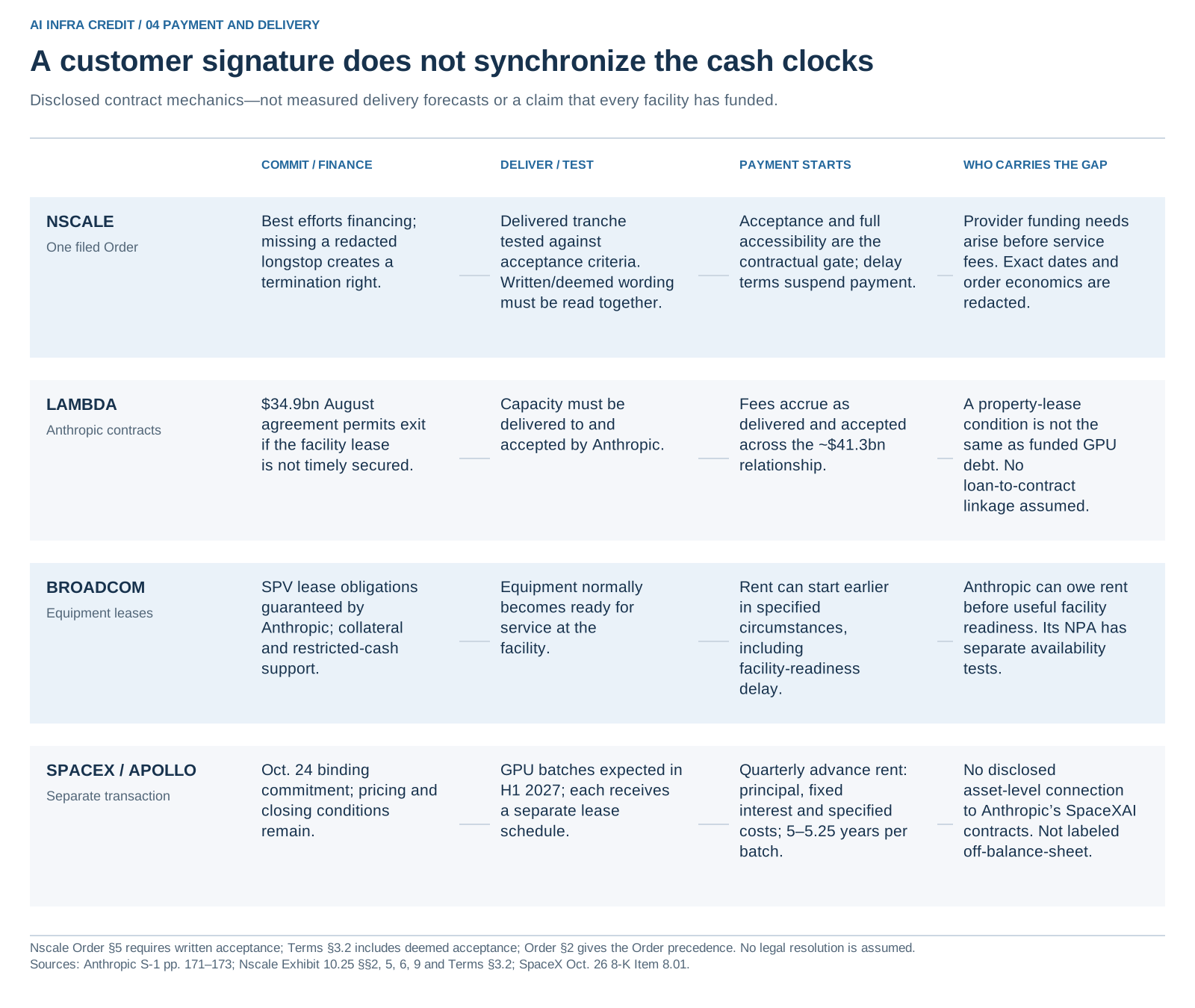
For a builder, the problem is funding equipment and installation before customer fees begin. A large order can support that financing, but lenders still need a workable path through the interval. For the customer, acceptance-linked payment protects against paying for unavailable service. The same clause can therefore improve procurement discipline while making supplier bridge capital more important.
Equipment rent can start before the facility is ready
Broadcom’s arrangements show the other side of the timing problem. The S-1 describes approximately $161.2bn of rent excluding interest across five-year equipment leases, normally beginning when equipment is ready for service. It also says rent can start earlier in specified circumstances, including a delay in facility readiness.
Two special-purpose subsidiaries enter the leases; Anthropic guarantees their obligations, and the equipment provides security. Restricted-cash support and cross-default provisions also apply. These are finance leases, not an automatic removal of obligations from Anthropic’s balance sheet. The June accounts already report $0.443bn of finance-lease liabilities; that recognized amount and the multi-arrangement future rent total answer different questions. S-1, MD&A pp. 172–173 and Note 7.
This is where “stranded compute” becomes a financing question without requiring a prediction of permanent stranded assets: how long can payment run ahead of productive use, and who funds that interval? Better deployment coordination and correctly timed liquidity can expand feasible capacity. A rent-financing facility helps only if its own eligibility conditions are satisfied when rent falls due.
SpaceX and Lambda illustrate different routes through the market
SpaceX’s October 26 8-K records an October 24 binding commitment to enter a master finance lease with an Apollo-managed entity. Expected aggregate principal payments are approximately $40bn, with rates to be set before execution and closing conditions still outstanding. The company expects closing before year-end and GPU delivery and lease commencements in H1 2027. Each batch has an approximately five- to five-and-one-quarter-year lease, with quarterly advance rent covering principal, interest and specified costs. SpaceX 8-K, Item 8.01.
Anthropic separately describes up to $120.5bn of SpaceXAI service spending through 2029. After initial non-cancelable periods ending in January and March 2027, either party may cancel on 90 days’ notice. That creates an interesting duration question, but the SpaceX 8-K does not identify those contracts as the new lease’s assets, collateral or pledged repayment stream. A corporate customer relationship is not an asset-level financing map.
Lambda provides a constructive comparator. Its October 1 announcement describes a $1.008bn secured, delayed-draw facility at a 6.78% fixed rate. DBRS rates the project borrower A(low) while identifying non-investment-grade parent risk. Contracted offtake and draw protections support the structure; installation, equipment reliability and reserve weaknesses remain. This is not proof that every borrower can still access debt, and the disclosed facility is not attributed here to Anthropic. Lambda announcement · DBRS rating rationale.
The useful bullish case is funded execution
The public filing supports a more concrete discussion than either “an $80bn cash burn” or “hundreds of billions of guaranteed capacity.” Anthropic had raised substantial equity and reported positive operating cash. Suppliers can provide equipment, services and conditional capital. What determines the next stage is whether those pieces meet on the same payment calendar.
Three observations would strengthen the expansion case: capacity delivered and accepted with manageable delays; financing conditions satisfied as payments activate; and operating cash that remains resilient as receivables, prepayments and vendor settlements normalize. Repeated readiness slippage, tighter issuance conditions or a widening interval between payments and useful service would weaken it.
The accounting also needs distinct labels. June Amazon-note principal was $6.203bn; convertible-note carrying value was $108.566bn; total liabilities were $117.467bn, already including that carrying value. Neither fair-value marks nor long-term contract ceilings are additional cash raised. The $265.6bn June purchase-commitment disclosure and approximately $245bn of later new or amended minimum payments cannot be turned into a reliable grand total without an overlap bridge.
The opportunity for finance is to fund the interval between credible demand and delivered compute. The analytical job is to identify who can carry that interval, on what terms, and for how long.
Download the source-linked dataset, reconciliation checks, figure generator and field guide. The earlier Anthropic series preserves its original dated framework; this report supplies the first public-S-1 cash and contract map. For the supplier-side cash question, see A Capex Gap Is Not a Bond Funding Gap.