A capacity reservation is not necessarily refundable cash. GE Vernova has described non-refundable upfront payments before projects enter its order backlog. That gives an equipment supplier a financing resource before all the customer's construction arrangements are ready. It does not turn an unfinished project into certain future revenue.
The distinction matters for anyone comparing customer-funded growth at GE Vernova and Vertiv. Three separate questions belong in the model: how much the reported cash-flow line contributed this period; under what conditions customers can recover money; and what still has to happen before delivery. One percentage cannot answer all three.
The cash commitment can precede the order
In its October 22, 2025 call, GE Vernova's CFO described upfront payments for both slot reservations and orders as non-refundable. This is positive evidence about the described arrangements, not a quantified allocation of the company's 2026 contract liabilities. Nor does a management description resolve every contractual remedy if the supplier fails to perform. Official transcript, page 21.
The sequence became clearer in March 2026. CEO Scott Strazik said customers had often paid 20–25% deposits while engineering, procurement and construction arrangements—or fuel arrangements—were not yet ready. Some data-center customers had not chosen the site to which equipment would be allocated. GE Vernova was not yet recording that equipment in backlog. The deposit range was a management description, not a universal required advance rate. March 18 conference transcript, pages 2–3 and 6.
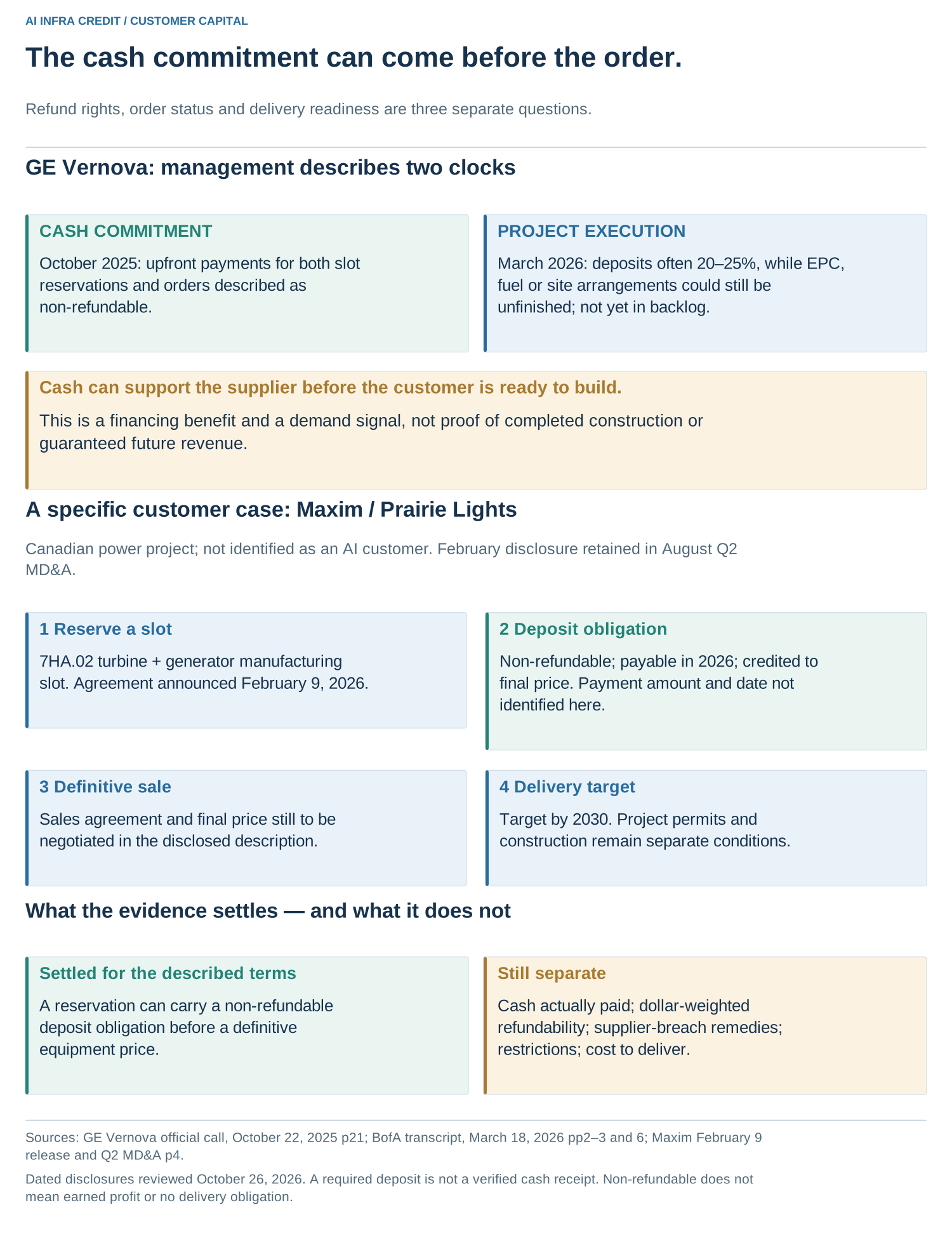
Maxim Power provides a concrete customer-side example. Its February 9 announcement reserved a GE Vernova 7HA.02 turbine and generator manufacturing slot, with delivery targeted by 2030. It required a non-refundable deposit payable in 2026 and credited against the eventual price, while leaving the definitive sales agreement and purchase price to negotiation. Maxim announcement.
The Q2 MD&A retained that description. The reported C$19.3m of Prairie Lights project spending is not a separately identified deposit amount; it cannot establish how much GE Vernova received. This is a Canadian power-project example, not an identified AI customer. Q2 MD&A, page 4.
The economic implication is constructive. A customer can make a costly commitment to scarce equipment while it continues to resolve the rest of a project. Once the advance arrives, the supplier gains financing; the customer secures a place in the production queue. But the supplier's cash position and the customer's project readiness are not the same risk. Neither a deposit nor an order alone makes a power plant operational.
The cash-flow percentage measures contribution not ownership
For the six months ended June 30, 2026, the relevant reported working-capital contribution was $1.8227bn at Vertiv against $1.8666bn of operating cash flow, or 97.65%. At GE Vernova it was $13.695bn against $10.680bn, or 128.23%. These are consolidated company figures, not AI-only receipts. Vertiv 10-Q, cash flows; GE Vernova 10-Q, cash flows.
The numerator is a net cash-flow adjustment: Vertiv's deferred-revenue line or GE Vernova's contract-liabilities-and-current-deferred-income line. It is not gross advance collections. A result above 100% means the other components, taken together, offset part of that contribution. It does not mean customers own more than 100% of the cash.
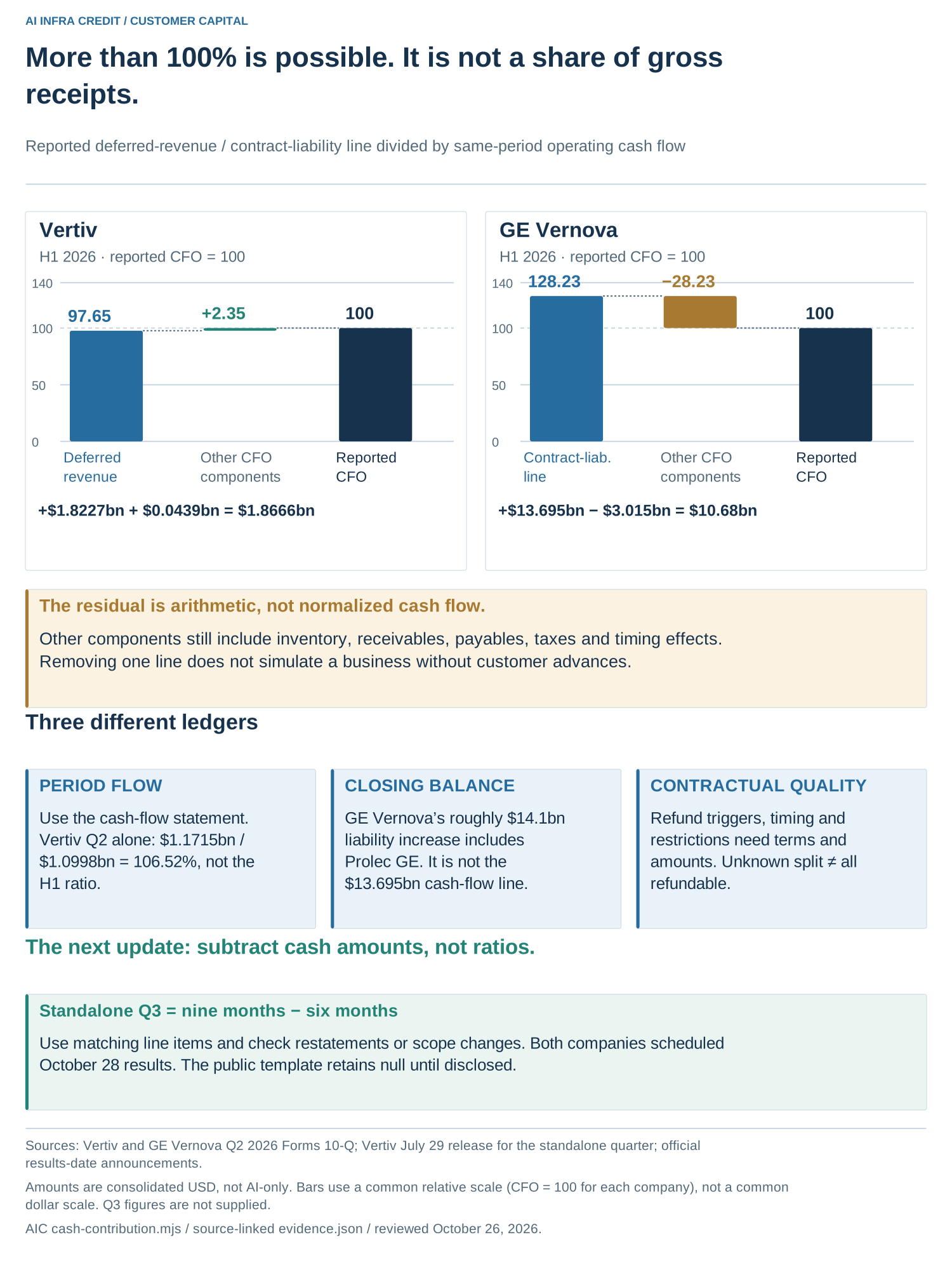
Subtracting the line leaves an arithmetic residual of +$43.9m for Vertiv and −$3.015bn for GE Vernova. It is not normalized operating cash flow: the remaining components still include inventory, receivables, payables, taxes and other timing effects. Nor does this subtraction simulate how the business would operate if it stopped taking customer advances.
Period selection also matters. Vertiv's standalone second-quarter contribution was $1.1715bn against $1.0998bn CFO, or 106.52%, rather than the half-year's 97.65%. Vertiv earnings-release cash-flow table.
Contract terms and accounting balances answer different questions
Vertiv's annual revenue policy generally describes cancellation, termination and refund provisions as applying after contract breach, with no historical invocation. That is useful contractual context. It does not allocate June's deferred-revenue dollars into refundable and non-refundable categories, and it should not be replaced by an assumption that every backlog order is noncancellable. Vertiv 2025 10-K, revenue policy.
GE Vernova's Note 9 describes a roughly $14.1bn liability increase that includes the Prolec GE acquisition as well as collections and revenue recognition. That balance movement is not interchangeable with the $13.695bn cash-flow contribution. The entire difference cannot simply be assigned to acquisition cash. GE Vernova 10-Q, Note 9.
The reviewed disclosures do not supply a dollar-weighted refundability split for the June balances or the period contributions. The right response is to preserve that gap while using the contractual evidence that does exist. “Not quantified” does not mean “all refundable.” “Non-refundable” does not mean “earned profit” or “no delivery obligations.”
Cash restrictions are a third question. Vertiv reported $65m of restricted cash; its annual policy describes collateral for bank guarantees and acquisition escrow. Neither disclosure identifies this as a customer-advance refund reserve. Netting it against deferred revenue would invent a linkage. Vertiv 10-Q, Note 8; annual policy.
What the next filings can settle
Both companies scheduled third-quarter results for October 28, before the market opens. As of this October 26 review, Q2 is the latest published quarter in the official materials checked. GE Vernova announcement; Vertiv announcement.
The first update is mechanical: derive standalone Q3 cash-flow amounts from nine-month figures less six-month figures, checking any reclassification or restatement. Subtract amounts, not percentages. A stronger test of funding quality then needs specific disclosure of refund triggers, timing, restrictions and the associated cash movements.
Three changes would alter the interpretation:
- A disclosed customer right to cancel for convenience and reclaim a material payment would weaken the retention assumptions for those contracts—not automatically the whole book.
- Conversion of reservations into orders, followed by delivery and revenue recognition, would improve execution evidence even if the net advance contribution slowed.
- A decline caused by refunds would mean something different from a decline caused by successful delivery. Gross additions, refunds and revenue conversion are needed to distinguish them.
The useful question is not whether customer funding is good or bad. It is whether the terms and timing let the supplier invest while leaving enough cash and capacity to perform. That is how customer capital can accelerate the AI equipment buildout without confusing early cash with completed demand.
Reuse the comparison
Download the source-linked observations, cash-flow calculator, results, next-quarter input template, checks and reuse guide. Unknown fields remain null; the template contains no Q3 estimates. Full-size PNGs: cash and order timelines and cash-flow bridges. Figure generator.
For the economics of pricing an advance from both sides, see The Price of Customer Capital.