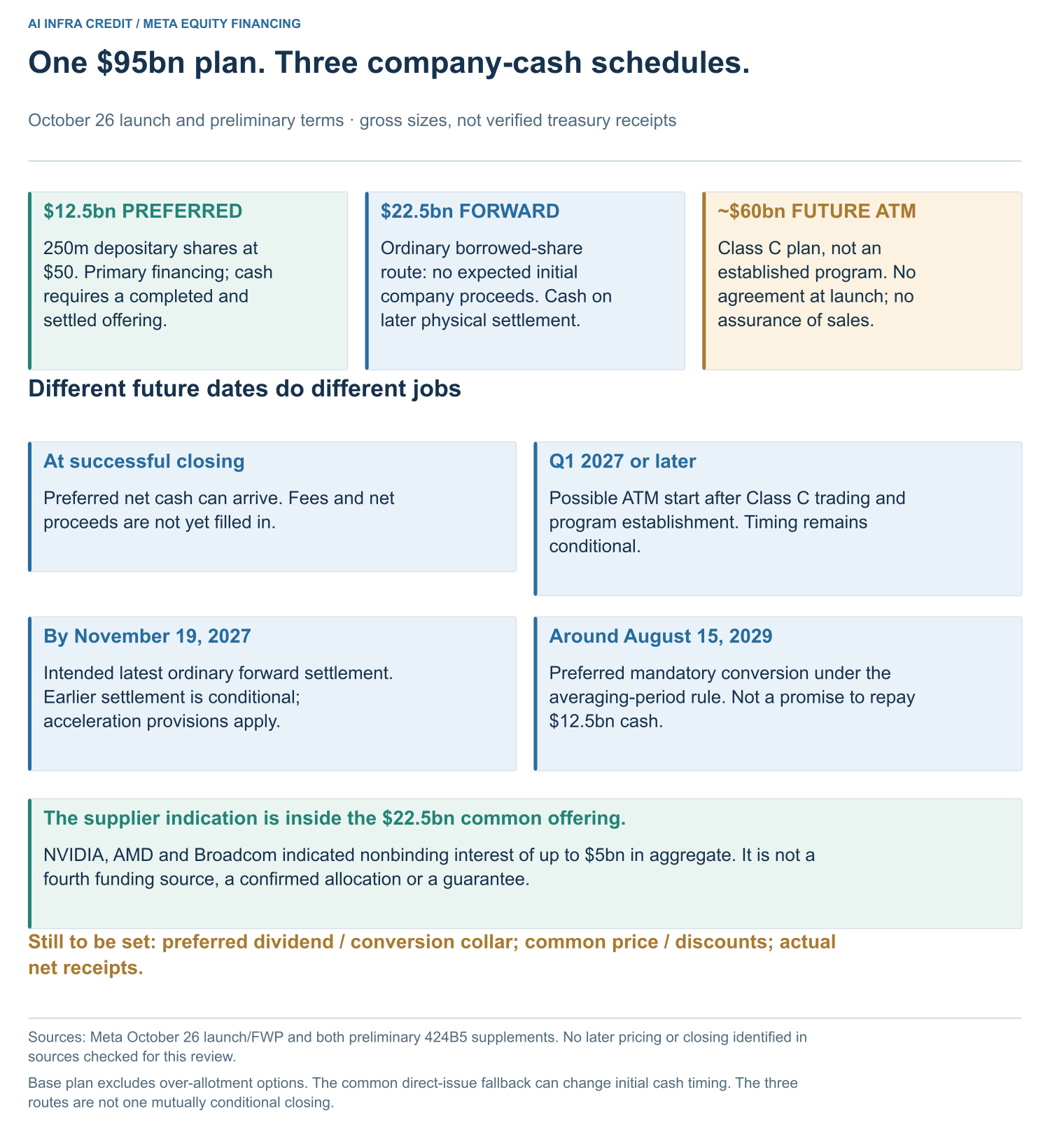
Meta is not simply choosing equity instead of debt. It is separating when investors take exposure, when the company receives cash and when common shares are delivered. Its October 26 plan combines roughly $12.5bn of mandatory-convertible preferred financing, $22.5bn of common stock sold through forward arrangements and a possible $60bn future at-the-market program. Those are three different capital schedules, not $95bn already in the treasury. Launch announcement.
This can be a constructive way to fund a long AI buildout: access an equity market before every construction invoice falls due, diversify funding and retain choices about later issuance. The price of that flexibility sits in forward adjustments, preferred distributions, conversion terms and the conditions on using each route.
One headline contains three receipt gates
The preferred/depositary offering is a primary issuance. It can provide company cash when completed and settled. The common forward ordinarily provides no initial company proceeds: shares borrowed by the forward sellers are sold into the market, while Meta receives cash at later settlement. The prospective Class C ATM is not yet an established program at launch. Filed launch communication.
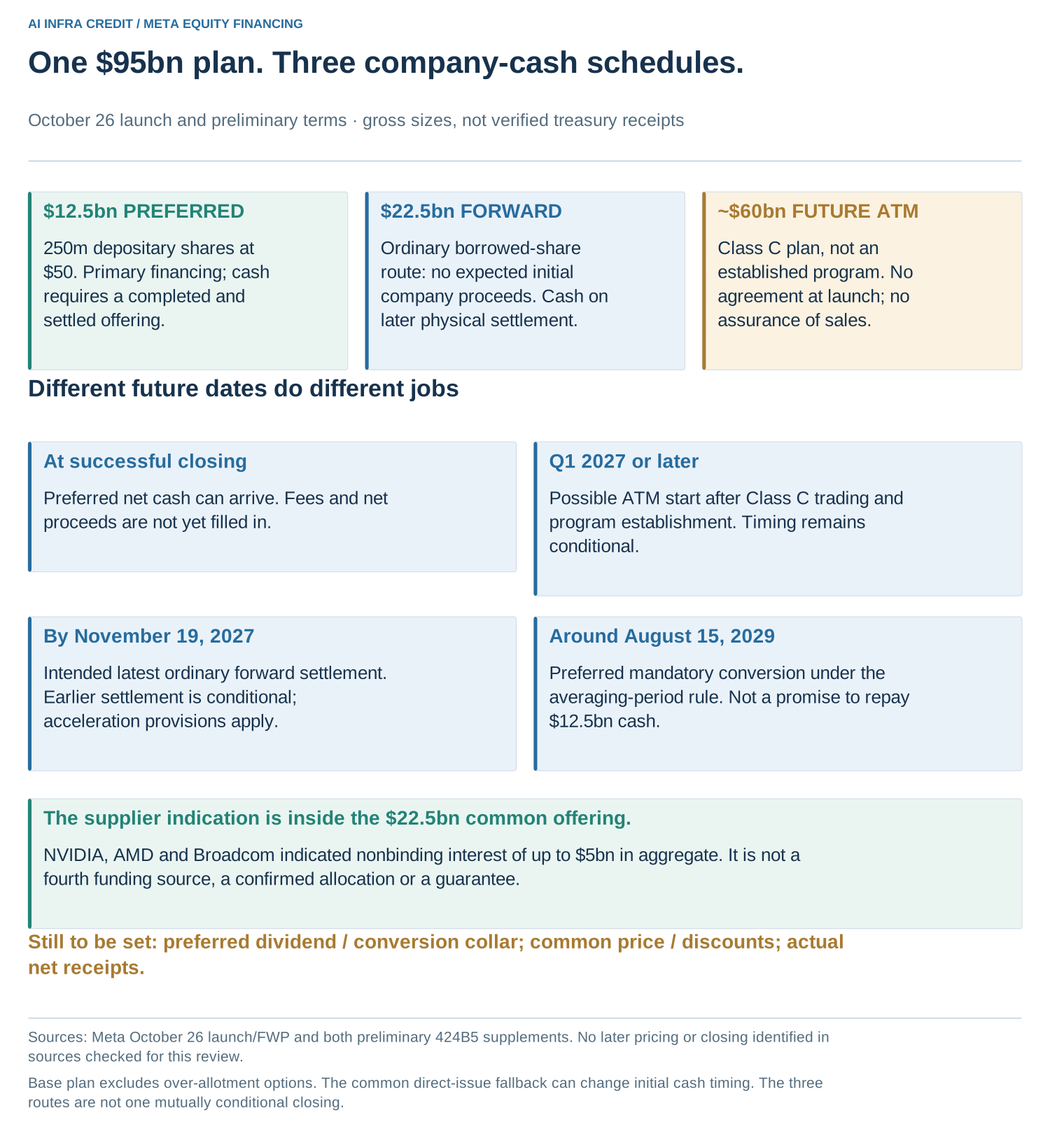
The reviewed October 26 supplements are explicitly preliminary, even though both were filed as Form 424B5. The common offering price and underwriting discount remain blank. The preferred summary states $50 per depositary share, but its dividend rate, conversion boundaries and net proceeds remain unfilled. No later pricing or closing was identified in the official sources checked for this review. Common supplement; preferred supplement.
The approximately $35bn launched package and $60bn plan also have different levels of execution certainty. There was no ATM distribution agreement at launch, and Meta did not expect that program to begin before Q1 2027, following Class C trading. Completion of the common and preferred offerings is not conditioned on completion of the other. The capital plan is modular, not one all-or-nothing closing.
NVIDIA, AMD and Broadcom indicated interest in buying up to $5bn in aggregate within the common offering. These are nonbinding indications, not an extra $5bn, confirmed allocations or supplier guarantees. Their participation could align capital providers with equipment demand, but the announcement does not establish a circular cash-flow arrangement.
The market sale and the company receipt are different events
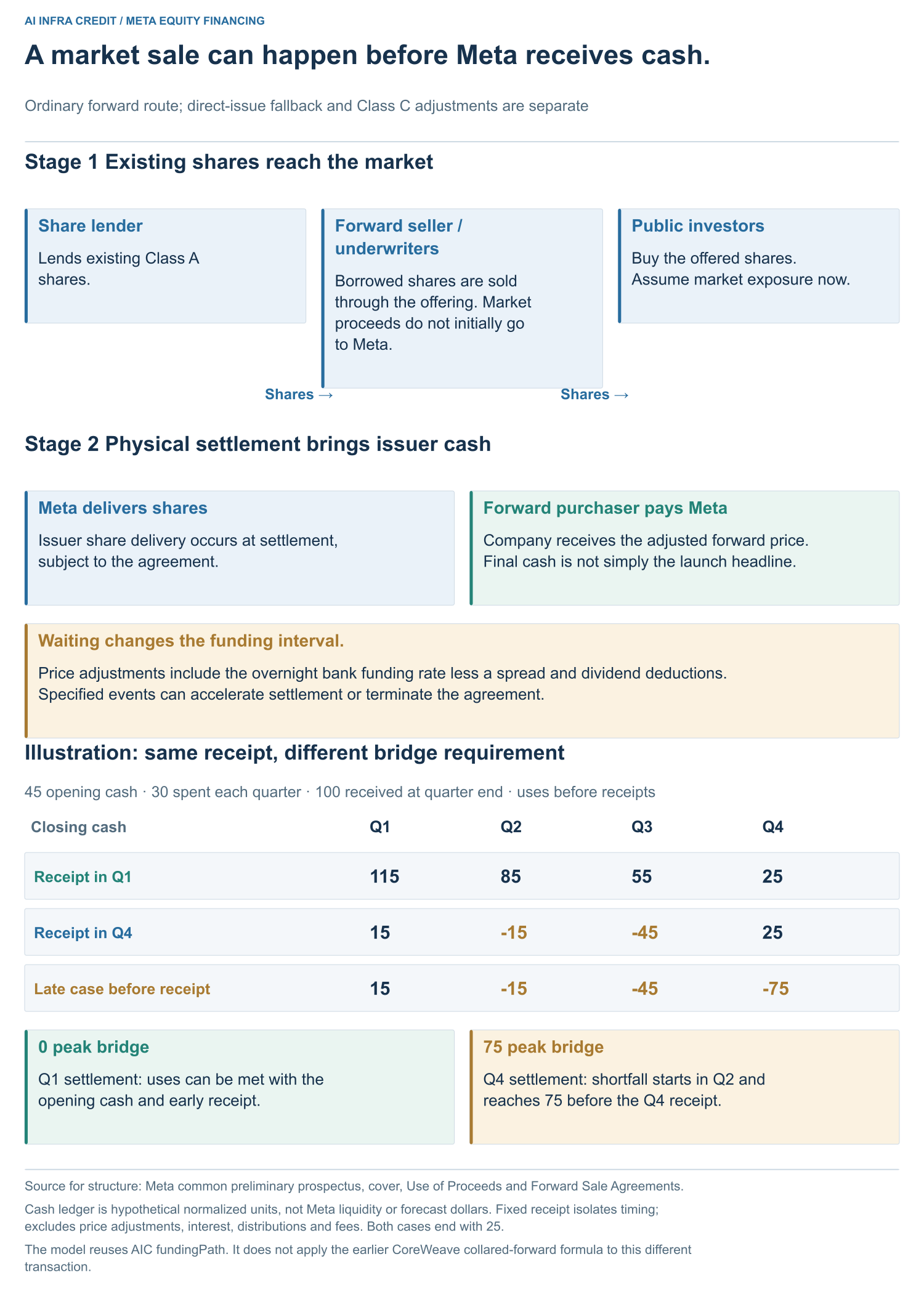
In the ordinary forward route, existing shares are borrowed and sold through underwriters. Meta intends to deliver shares and receive the adjusted forward price on settlement dates it selects, subject to conditions, no later than November 19, 2027. If the sellers cannot borrow or deliver the relevant shares under specified conditions, Meta instead directly issues the shortfall. Therefore “no initial proceeds” describes the ordinary route, not every outcome. Common supplement, cover and Use of Proceeds.
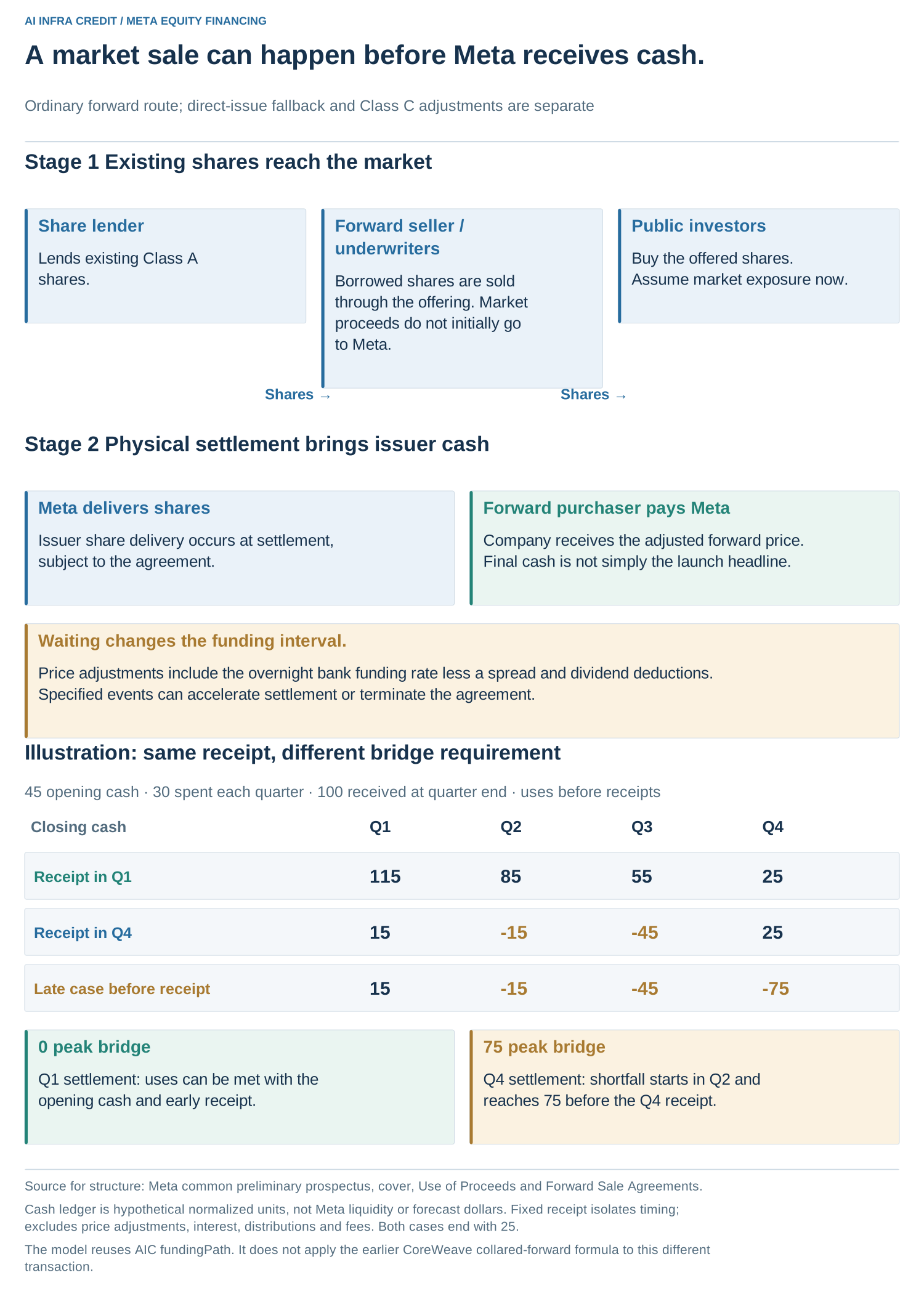
The forward price is not a fixed cash amount waiting untouched. It adjusts with the overnight bank funding rate less a spread, expected-dividend deductions and applicable Class C adjustments. Borrowing conditions and specified events can accelerate settlement or trigger termination. Meta also expects derivative fair-value accounting, so reported earnings and diluted-EPS effects can precede physical issuance. Common supplement, Forward Sale Agreements.
The financing trade-off is therefore a timing decision, not a free option to ignore the market. Early settlement provides usable liquidity and brings issuance forward. Later settlement can better match planned spending, but leaves the company dependent on an intervening cash source and the agreement's continued operation. Accounting dilution, economic exposure, ordinary voting rights and delivered shares need separate dates.
To isolate timing, assume a company starts with 45 cash units, spends 30 in each of four quarters and receives 100 at the end of Q1 or Q4. Uses precede receipts within a quarter. Both cases finish with 25. Yet the Q4 case needs 75 of peak bridge funding, first showing a shortfall in Q2; Q1 settlement needs none. This is not Meta's liquidity forecast. It holds the receipt fixed and excludes price adjustments, fees, distributions and bridge interest; those determine whether waiting is worth its cost.
Preferred capital brings cash before common conversion
The base offer consists of 250 million depositary shares at a stated $50 each. Each represents one-twentieth of a preferred share with a $1,000 liquidation preference. That is $12.5bn gross, not net proceeds. The over-allotment option is another 37.5 million depositary shares, or $1.875bn at $50, if exercised. Preferred supplement, offering summary.
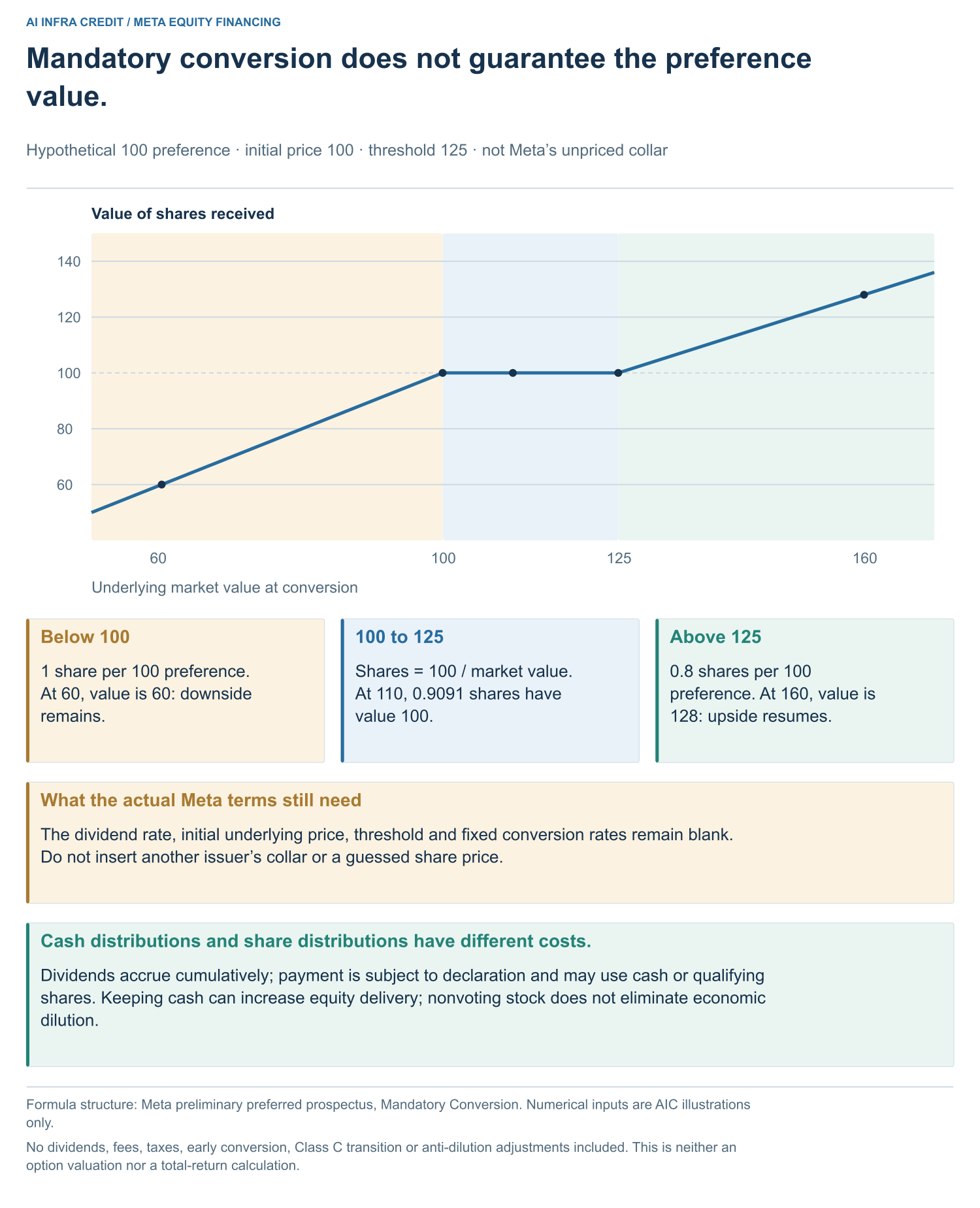
Mandatory conversion is expected around August 15, 2029, under a specified averaging-period rule. The numerical collar is unpriced. Below the initial underlying price, a maximum share count applies; within the middle band, conversion value is held at the preference by a variable share count; above the threshold, a minimum share count participates in further upside. The preference is not a guaranteed cash repayment at conversion.
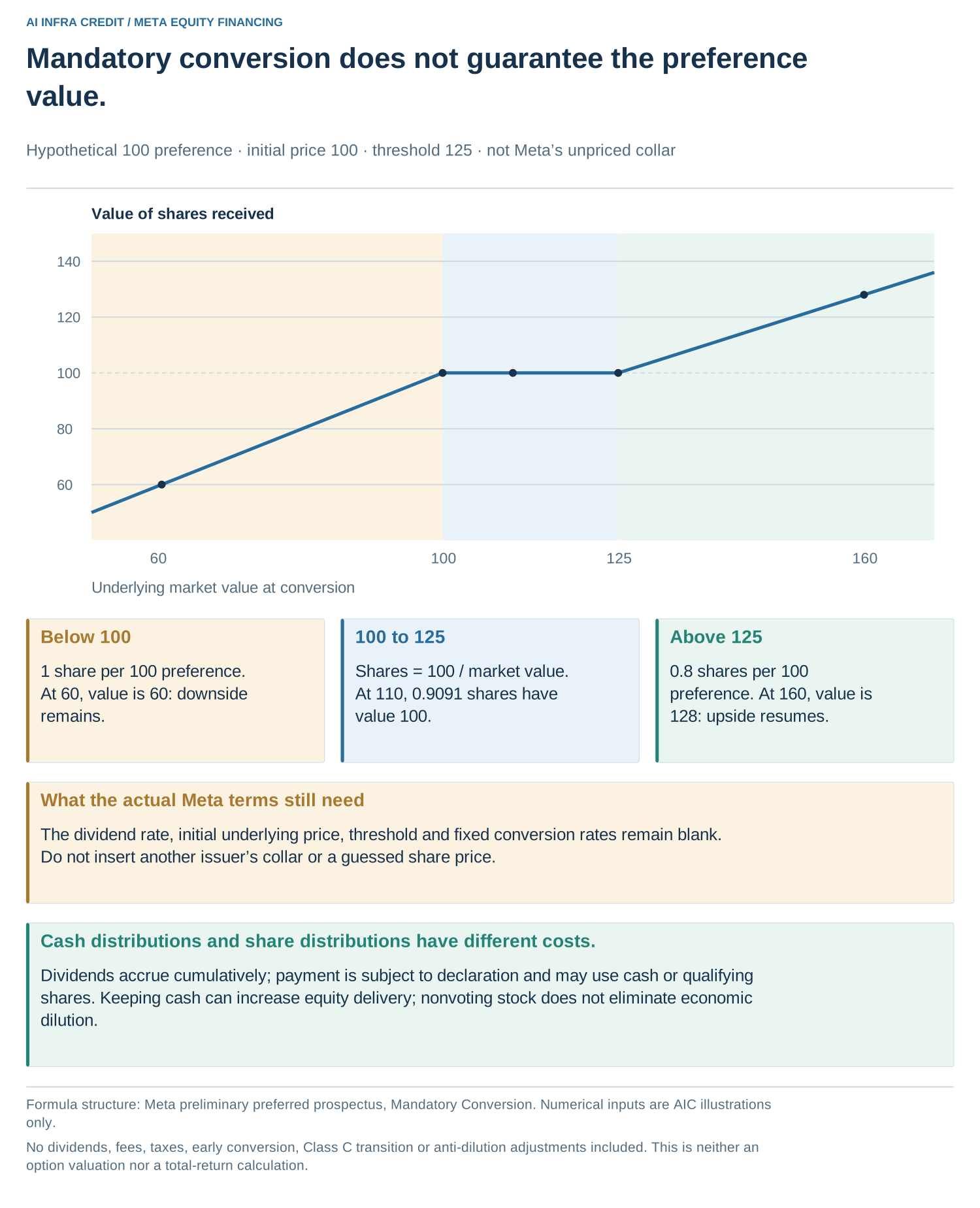
The illustration uses preference 100, an assumed initial price of 100 and threshold of 125. A market value of 60 produces one share worth 60; at 110, about 0.9091 shares are worth 100; at 160, 0.8 shares are worth 128. The investor retains downside below the lower boundary and participates above the upper boundary. Dividends, taxes and adjustments are excluded; this is a payoff illustration, not Meta's actual collar or a total-return calculation.
Dividends would accumulate under the proposed terms, but declared payments may be made in cash, qualifying stock or a combination. A headline dividend rate, when available, will therefore not automatically be an all-cash coupon. Paying in shares preserves cash by transferring more equity economics—not by making the distribution free.
Nonvoting stock separates control from economic ownership
Class C introduces another distinction. Its ordinary voting rights differ from Class A and Class B; issuing nonvoting shares can preserve voting control while still diluting economic ownership. The declared pro rata Class C share distribution itself is not a new cash raise.
The contract triggers are more specific than a calendar date or “Class C exists.” The forward mechanism requires issuance in the Class C distribution and qualifying listing approval. The preferred conversion trigger has an April 15, 2029 deadline, while the switch for stock-paid dividends also depends on an issuance anniversary. Relative-price and conversion adjustments matter. These are conditional mechanics, not a basis for treating future Class C shares as economically identical at any assumed price. Common summary; preferred terms.
What makes this a useful AI financing structure
The opportunity is to connect a long construction program with more than one capital market and more than one receipt date. Preferred capital can arrive before common conversion; forward equity can separate market execution from the issuer's cash need; a later ATM can add issuance flexibility. None eliminates the need to compare capital cost with the returns and timing of the assets being built.
The next useful evidence is specific: final preferred economics and net proceeds; executed forward terms and actual settlements; Class C issuance and trading; and an established ATM with actual sales. A supplier's indication becoming an allocation is another distinct event. These observations determine what the plan finances and at what cost.
Our four-company operating-cash-minus-cash-PP&E comparison remains unchanged. An equity announcement does not alter historical operating cash or score that forecast. It answers the adjacent question: which capital source can meet the next invoice, and what does using it transfer to investors?
Reproduce the illustrations
Download the dated evidence, model, reused cash-ledger dependency, results, checks, figure generator and guide. Actual net receipts, dividend costs and conversion shares remain null. Full-size PNGs: three cash clocks, forward and funding, conversion trade-off.
Preserving control does not prevent economic dilution
October 26 contract follow-up. Meta's signed Founder Alignment Agreement makes the distinction explicit: future Class C issuance can dilute every existing shareholder's economic interest, including the founder's. What nonvoting issuance can preserve is the existing ordinary-vote denominator. The agreement was executed on October 20; the 8-K reports an October 19 earliest event and was filed on October 21. These are not three execution dates. Signed agreement, recitals · 8-K, Item 1.01.
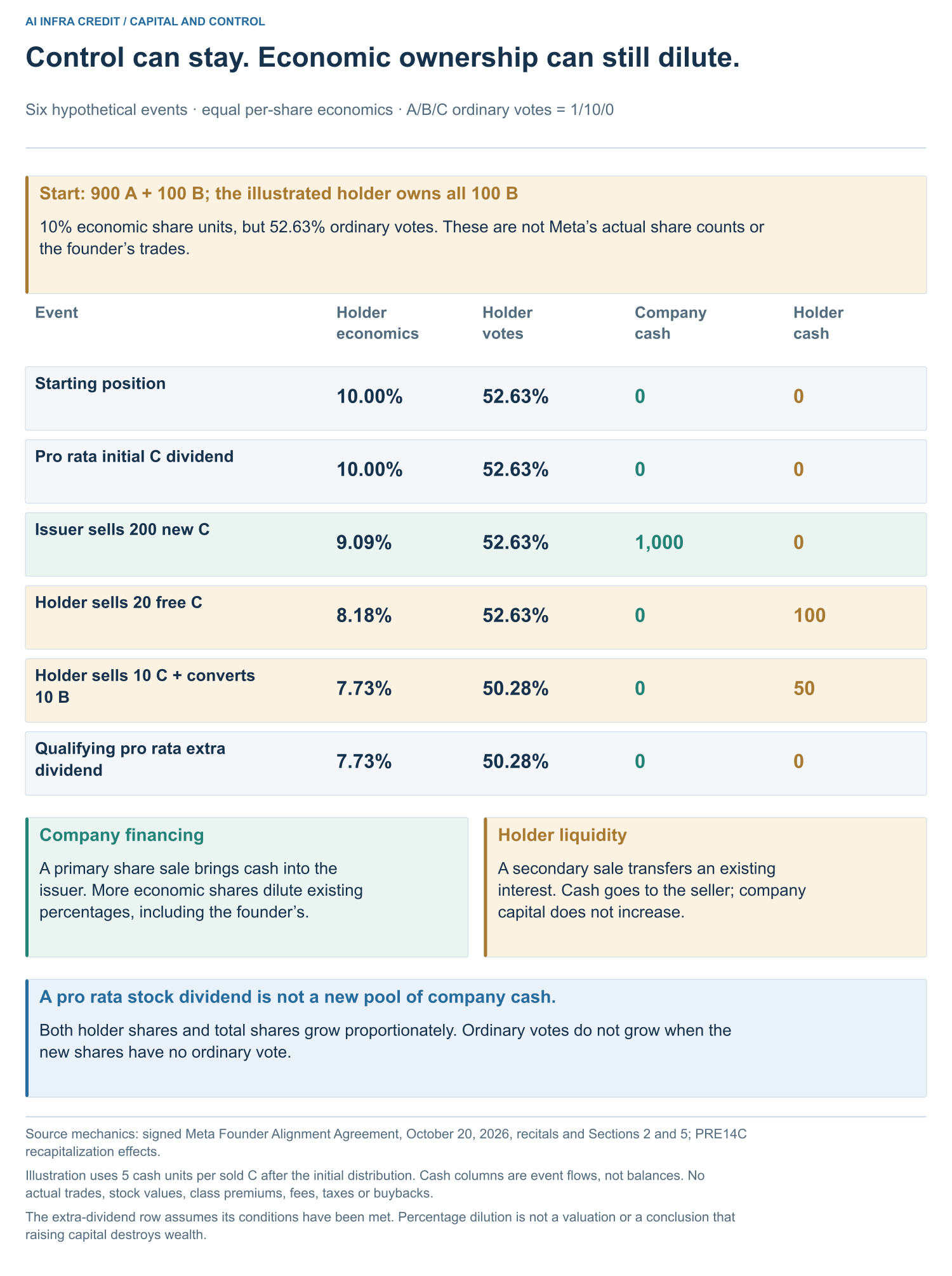
Four events therefore belong in different ledgers. A pro rata stock dividend changes share counts, not who owns what percentage at that instant. A primary sale of new shares brings cash to Meta and dilutes existing economic percentages. A founder's secondary sale brings cash to the seller, not Meta. A B-to-A conversion can reduce votes without reducing the converting holder's economic share count.
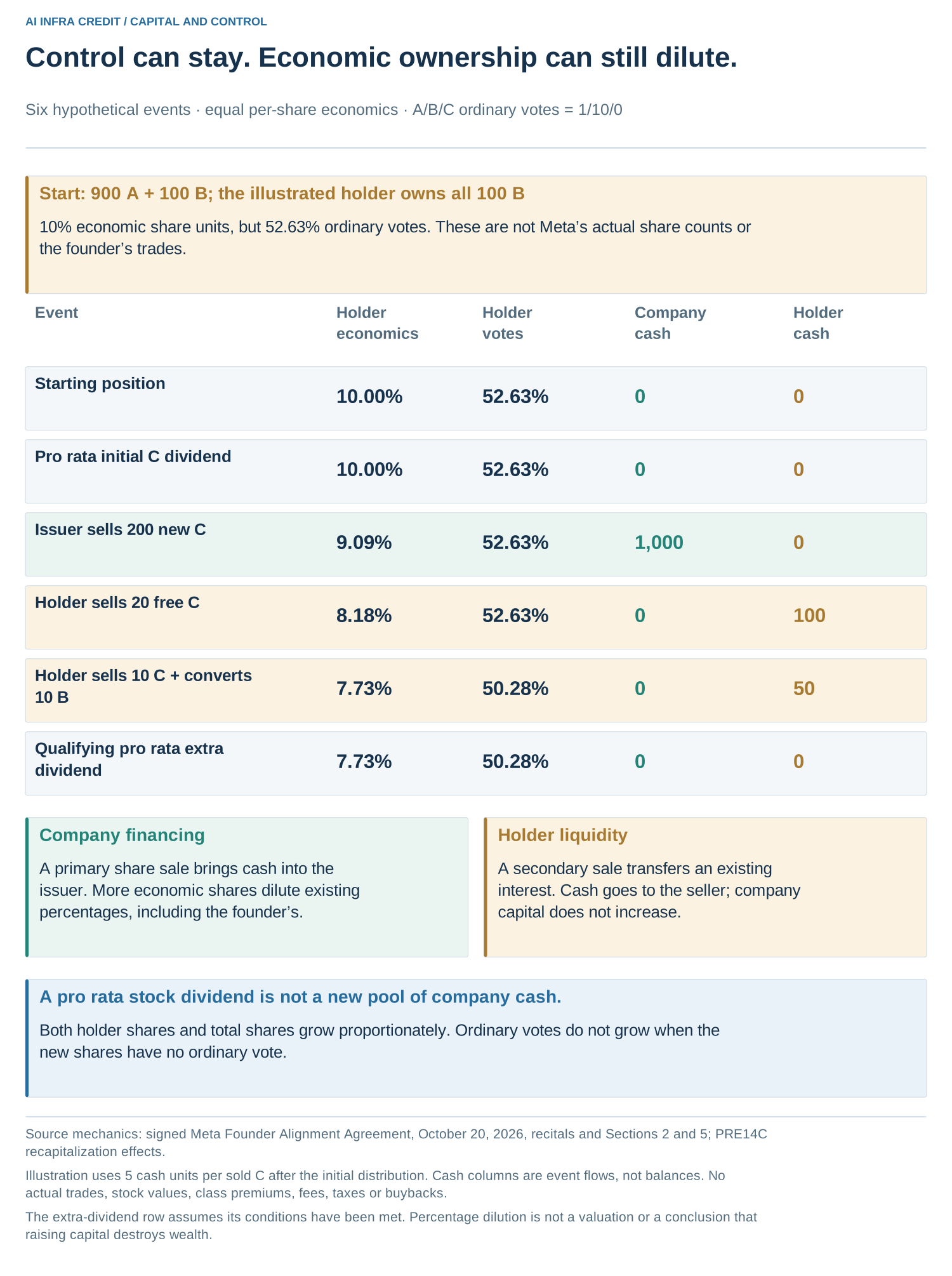
The illustration begins with 900 A and 100 B shares, the holder owning all 100 B. With ordinary voting weights of 1, 10 and 0 for A, B and C, that is 10% of economic share units and 52.63% of votes. After the initial C distribution, selling 200 new C to outside investors at an assumed five cash units each raises 1,000 for the company. The holder's economic fraction falls to 9.09%, while its vote percentage stays 52.63%.
Selling 20 existing, unstapled C then pays 100 to the holder and nothing to the company. Selling another ten C with a paired conversion of ten B into A pays the holder 50 and changes its vote fraction to 50.28%. A subsequent qualifying pro rata C dividend changes neither percentage. These are hypothetical share units, not Zuckerberg's actual holdings, trades or proceeds. They measure ownership fractions, not class-specific trading values or total wealth.
Percentage dilution is also not, by itself, evidence of value destruction. The company receives capital or other consideration when it issues shares; what it pays for that capital and what the funded investment earns determine the economic result. Class C separates that question from ordinary voting control. PRE14C, recapitalization effects.
The founder agreement governs liquidity rather than creating company cash
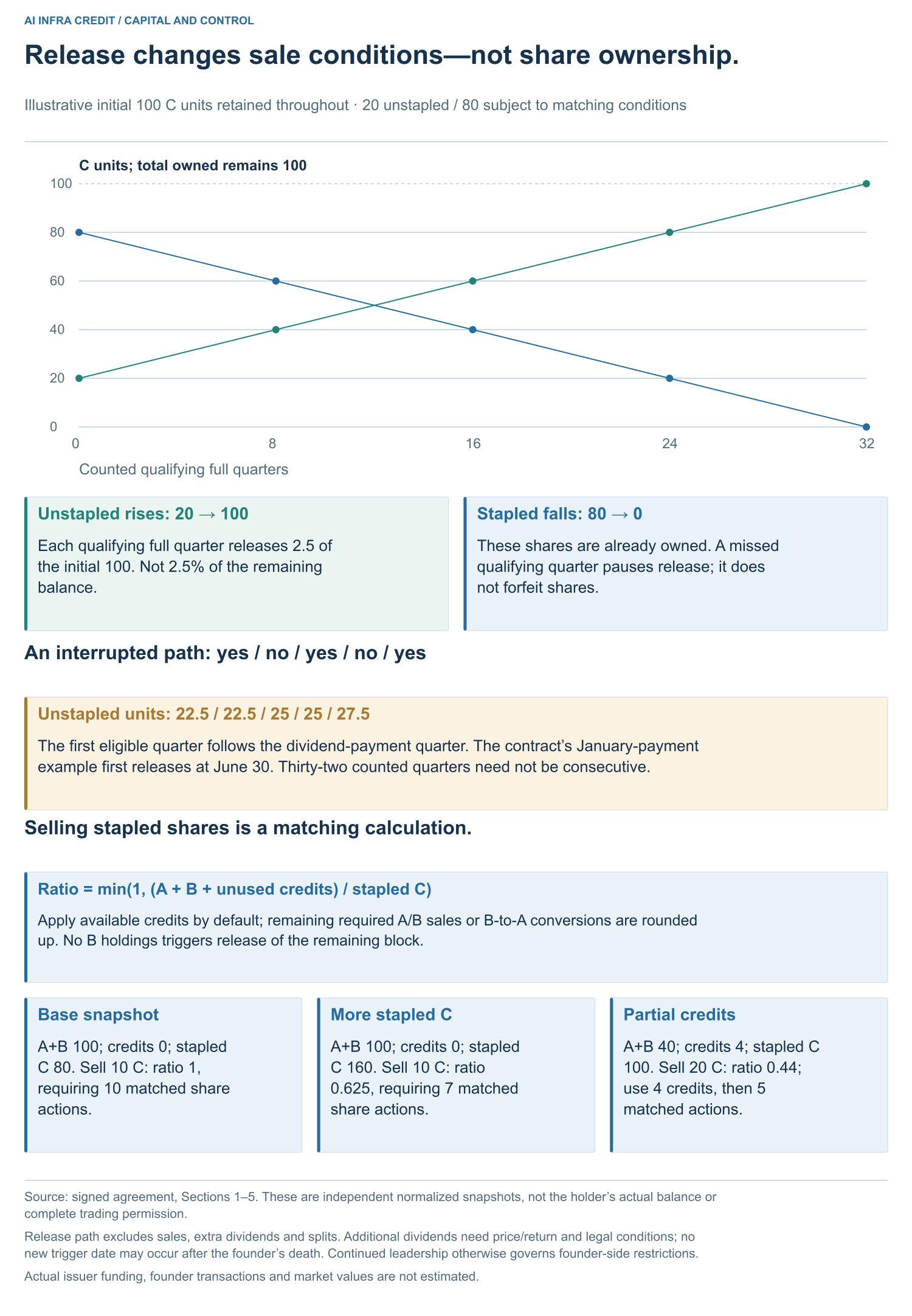
The initial holder-group C distribution is 20% unstapled and 80% subject to matching conditions. Selling the latter generally requires an accompanying A/B sale, B-to-A conversion or use of credits; the ratio can be below one-for-one. It is a constraint on monetization, not a blanket prohibition on selling for eight years. Agreement, Sections 1–3.
The release schedule uses 2.5% of the initial C distribution per qualifying full quarter, not 2.5% of the remaining restricted balance. Thirty-two qualifying quarters need not be consecutive. A quarter without qualifying full-time leadership pauses the release count; it does not forfeit already-owned shares. The agreement's example puts the first release after a January payment at June 30, not March 31. 8-K summary.
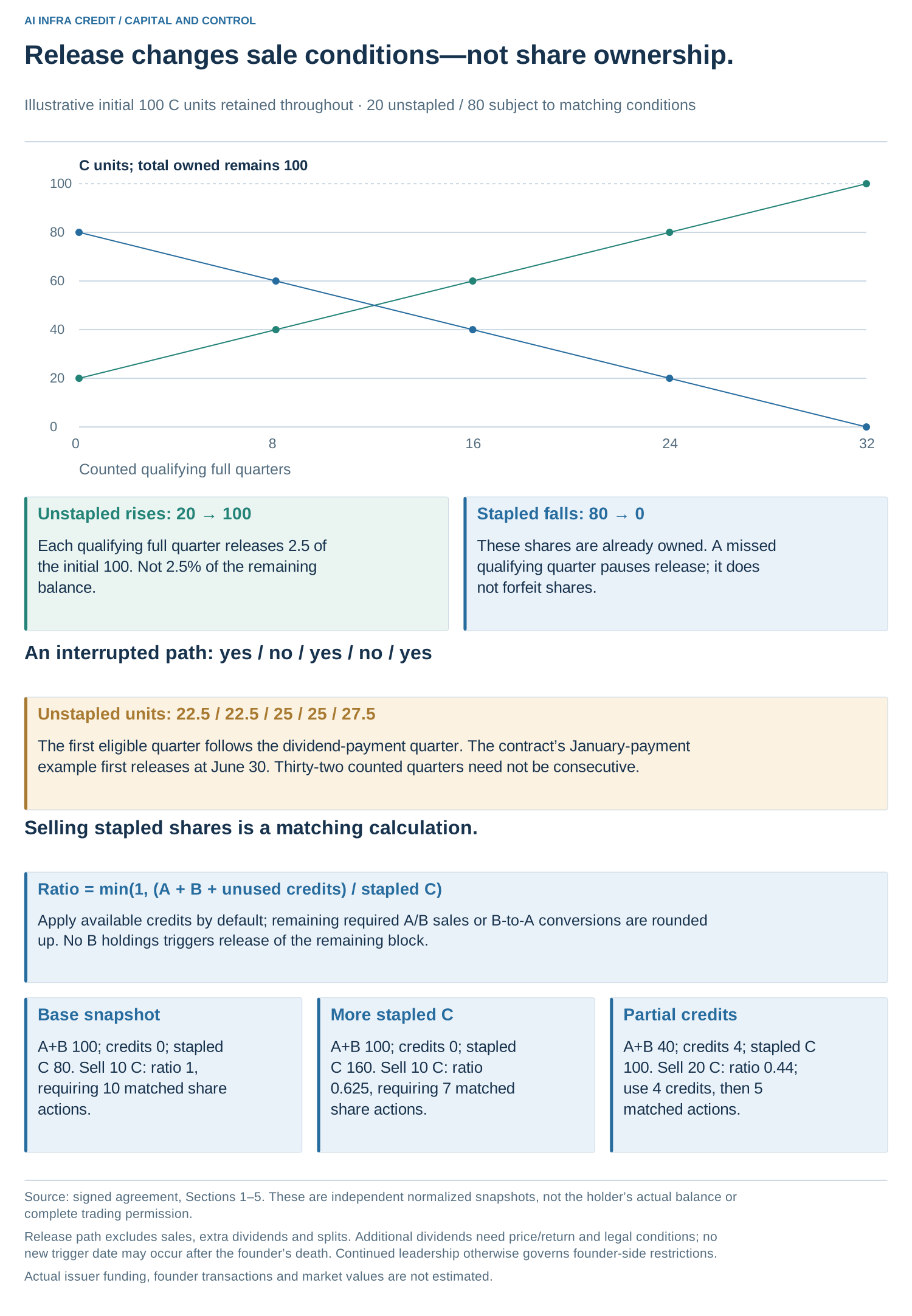
Additional C dividends require both specified price-doubling and annualized-return conditions, plus the contractual process and legal availability. They go pro rata to all then-outstanding A, B and C—not solely to the founder. Continued leadership generally determines restrictions on the holder group's new shares rather than whether other shareholders receive the dividend. Death is a separate limit: no new Additional Dividend Date may occur after the founder's death. Ordinary capital issuance does not reset the agreement's performance price measures. Agreement, Sections 1 and 5.
For capital providers, the important trade-off is durable decision authority alongside a changing economic stake. That can support investment across a long development cycle, while making the design of incentives, liquidity constraints and investor protections more important. Neither voting control nor a pro rata stock dividend makes external capital free, and founder monetization should not be counted as funding for Meta's AI assets.
Reuse the ownership and release checks
The evidence register, calculator, results, checks and guide keep cash recipients, share counts and votes separate. Four independent stapling snapshots illustrate the ratio, default credit use and the no-B release override; they do not determine complete permission to trade or implement the entire agreement. Full-size figures: economics, votes and cash and release conditions. Figure generator.